Discover the history of Puglia - Italy's hidden gem
.jpg)
Puglia’s history, like that of so many parts of southern Italy, is a tangled web indeed! Its strategic position and its fertile soil made it an attractive proposition for colonization and all the usual suspects, Mediterranean and non, invaded at one time or another. While exploitation was usually the name of the game, each conqueror bequeathed a cultural, architectonic and gastronomic patrimony whose fascinating eclecticism remains for all to see.
Here below is a brief summary of Puglia's multifaceted history:
A brief historical timeline
1st millennium BCE: Pre-Greek civilisations
Illyric and Italic peoples settle.
8th century BCE - 272 BCE: The Greeks
Greeks from Sparta begin to arrive in the 8th century BCE. They settle first in Salento (the southernmost part of Puglia, where still today there is a Greek dialect called Grika) and gradually move northwards. One of their major cities is Tarentum (modern-day Taranto).
272 BCE - 476 CE: The Romans
272 - the Romans oust the Greeks and rapidly colonise the region. Wheat, olive oil and wine are produced en masse to help feed the mouths of the expanding empire.
216 - Hannibal crushes Roman forces at Cannae in Puglia (one of their worst ever defeats) during the Second Punic War, but the Romans eventually retain control of the region, which continues to thrive as an agricultural centre and trading post for the east.
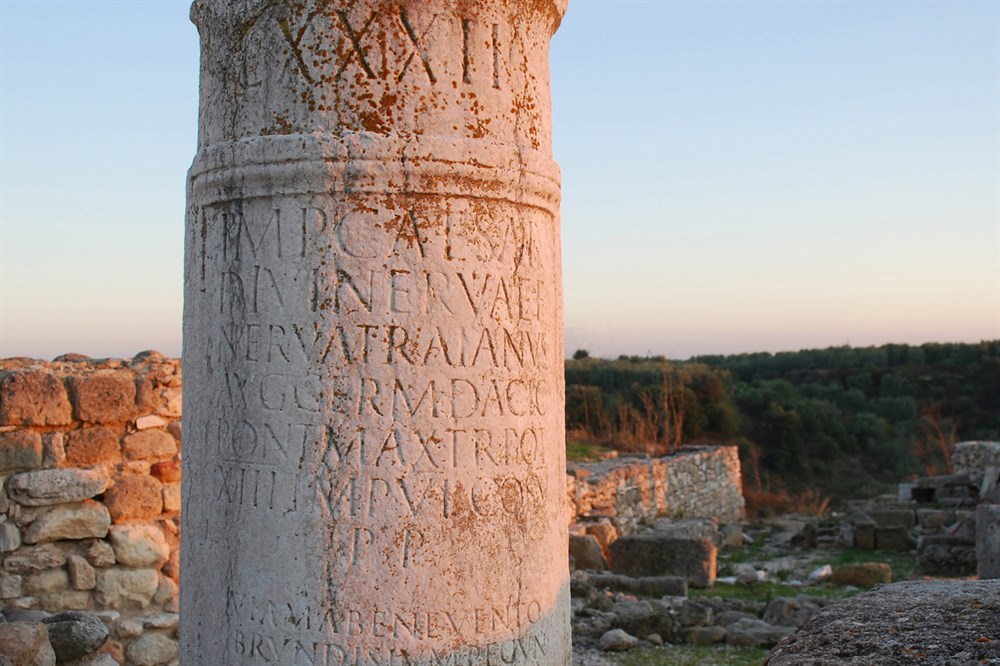
190 - the Romans complete the Via Appia, linking Rome with Puglia. The amphitheatre in Lecce dates from around 100 years later.
476 AD - fall of the Roman Empire.
554 circa - 1059: The Byzantine Empire
After a brief incursion of the Lombards, Puglia become part of the Byzantine Empire. It is during this time that the island town of Gallipoli is fortified. Saracens from North Africa frequently attack Puglia but never manage to take it.
1059 - 1200 circa: The Normans
1059 - Robert Guiscard, a Norman, forms the Duchy of Apulia. Later in the century the Normans conquer Sicily where they establish their power base. Puglia becomes a provincial outpost under Norman rule.
1087 - sailors bring the relics of San Nicola to Bari and the Basilica di San Nicola is built in this period.
1200 - 1250: Frederick II
Frederick II, Holy Roman Emperor, aka “Stupor Mundi” inherits Puglia, where he spends much of his time when away from Sicily. His enlightened reign sees a flourishing of the arts and a period of relative peace and prosperity. Many of his castles, such as Castello Svevo in Trani and Castel del Monte in Andria, survive, along with some wonderful Romanesque constructions such as the Cattedrale di San Sabino in Bari.
1250 - 1500 circa: The Angevins
After the death of Frederick II and the end of the Hohenstaufen line, the Angevin dynasty from France incorporates Puglia into the Kingdom of Naples.
1480 - a Turkish force under the command of Gedik Ahmed Pasha lays siege to Otranto. On capturing the town, all male inhabitants over the age of 15 (numbers in the 1000s) are killed. The aging Archbishop, refusing to renounce his faith, is cut into pieces in public and his decapitated head paraded through the town on a pike.
1500 – 1713: The Aragonese
1500 - King Ferdinand V of Aragon takes the reins and over the next 50 or so years, Otranto, Bari and Taranto are fortified against Turkish invasions.
1713 -1734: The Austrian Habsburgs
1713 - the Treaty of Utrecht grants Puglia to Austria
1734 - 1806: The Bourbons
1734 - the Spanish Bourbons defeat Austria at the Battle of Bitonto and reclaim Puglia as their own. The Turks and the Venetians attack repeatedly hoping to gain a foothold in the region.
1806 - 1815: The French
1806 - during the Napoleonic Wars, the French seize control of much of southern Italy, including Puglia. They abolish feudalism and reform the justice system. Joachim Murat, Napoleon's brother-in-law, builds a new octagonal centre in Bari, Puglia's capital, thus creating a city of two halves, one of which is known as Bari Vecchia.
1815 - 1860: The Bourbons
1815 - with the end of the Napoleonic Wars, Puglia comes under Bourbon rule once more.
1861 - 1946: The Kingdom of Italy
1860-1861 - Italy is united and Puglia becomes part of the Kingdom of Italy
1922 - Mussolini intensifies the production of grain, olives and wine in Puglia as Italy attempts to become self-sufficient.
1943 - the Allied invasion ousts German forces, and the ports of Bari, Brindisi and Taranto undergo heavy bombing from both sides.
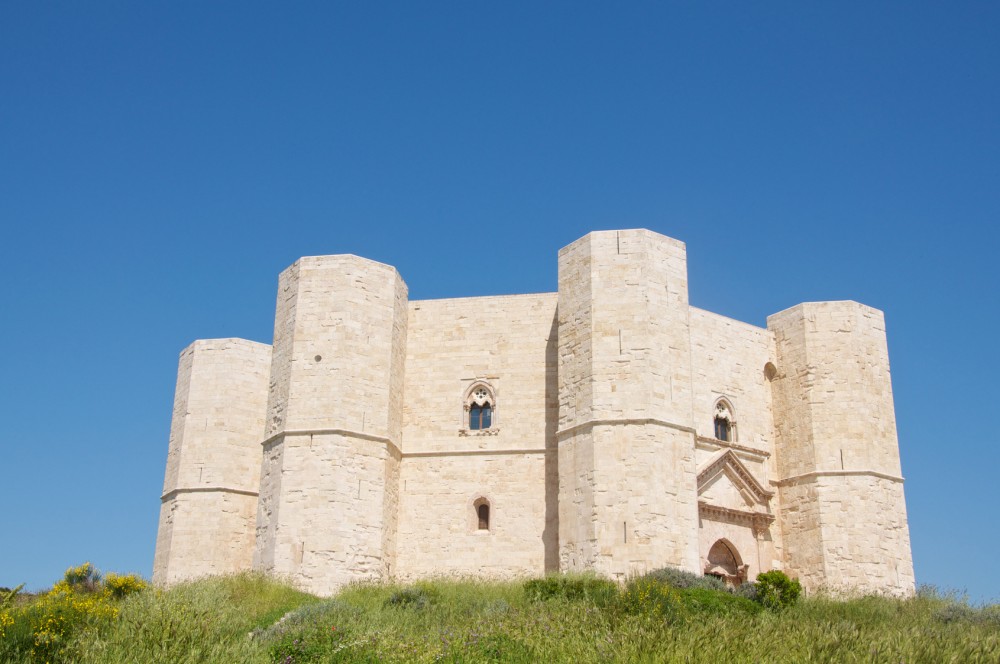
Barletta (just north of Trani on the coast) - originally a Norman fortress complete with moat, it was transformed by Frederick into a royal palace with more grand, sophisticated architectural features.
Bari – originally built by King Roger II of Sicily, Frederick rebuilt it virtually from scratch after it was destroyed in 1156.
strong>Lucera (just north of Foggia) - built in 1233 on the foundations of a pre-existing cathedral. The Angevin King Charles I later made significant changes, but the two cylindrical towers of Frederick’s original design remain.
Gravina in Puglia (near Altamura) - built around 1231 as a lodge for Frederick’s favourite pastime of hunting with birds. Frederick particularly liked the area, defining it as a “garden of delights”. There is not a lot left to see now, however.
Oria (right in the centre of Puglia between Taranto and Brindisi) – Frederick enlarged the already existing fortress between 1227 and 1233, accentuating its triangular form and making it fit for a Holy Roman Emperor’s wedding party.
Brindisi - built in 1227 and later modified and expanded by Ferdinand I of Aragon and Charles V. Brindisi was one of the main departure points for the Crusades, and so the castle had a special importance.
Gioia del Colle (in the centre of Puglia between Taranto and Bari) - built in about 1100 by Richard Seneschal, but later significantly modified by Frederick. It was here that he kept his mistress Bianca Lancia locked up… but that’s another story!
Otranto - although very little remains of Frederick's reinforcements of these impressive fortifications, any excuse to go to Otranto is a good excuse!
Trani (on the coast just north of Bari) - built between 1233 and 1249, it is one of our favourites! Right on the sea, the castle once had a moat that filled up with sea water.
The History of Hannibal at Cannae, Sicily
Cannae in Puglia, Scene of Hannibal's greatest triumph
Hannibal’s famous crossing of the Alps in 218BC was a miraculous feat, but his finest hour came over two years later!
His arrival in Cisalpine Gaul sent a series of shockwaves through the peninsula that would only grow in intensity the further he headed south. Everywhere he went, Hannibal triumphed. Each victory was bigger and more glorious than the last until, at the Battle of Cannae, in 216BC, the Romans were dealt such a severe blow that European and Mediterranean history could easily have been changed for ever.
At the Battle of Trebia in 218BC and the Battle of Lake Trasimene in 217BC, Hannibal easily out-thought and out-manoeuvred Rome's legions and their impulsive generals, Tiberius Longus and Gaius Flaminius.
The Battle of Lake Trasimene ranked as one of the Roman Empire’s greatest ever military disasters, with around 30,000 legionaries being killed or captured by the Carthaginian invaders. Rome itself was now at Hannibal’s mercy and drastic action was required. The decision taken was to bring back the role of Dictator, and Quintus Fabius Maximus was entrusted with the job of saving the patria.
Fabius was a man with a plan, though not a plan that the Romans liked. It was a plan that went against the very grain of Roman military thinking and against the whole essence of what being Roman stood for. Fabius’ plan was to delay, to avoid, to wear down but never to enter into a battle with the Carthaginians.
Hannibal tried to lure him into traps, to bait him and to inspire bellicose thoughts, but Fabius resisted temptation. The more he kept Hannibal at an arm's length, however, the more the Roman people derided him, not realising that his tactics, soon to go down in history as Fabian Strategy, were having the desired effect. The Senate too, had had enough, and at the beginning of 216BC, Fabius the Dictator was replaced by two Consuls, Gaius Terentius Varro and Lucius Aemelius Paullus.
The two new Consuls, spurred on by public sentiment, raised a fighting force of somewhere between 60,000 and 100,000 men (no one seems to be able to agree on the exact number). This massive army was soon marching towards Puglia, where Hannibal was waiting just outside the town of Cannae, about 70km north of modern-day Bari.
When the two Consuls arrived, however, they were unable to agree on the best tactics. Paullus reasoned that the flat surrounding land was ideal for Hannibal’s expert cavalry and that it would, therefore, be better to steer the battle to hillier ground where horses would be less effective. Varro, on the other hand, noting that the Roman army was nearly twice as large as Hannibal’s, was impatient to restore Rome’s pride immediately, there and then.
The two Consuls had equal powers and neither could overrule the other, so who would take the decision? According to Roman tradition, the supreme command of the army alternated between the two Consuls on a daily basis and it was on Varro’s watch that the massive Roman army lined up against the cunning Hannibal and his forces.
Varro initially deployed a conventional 3-line maniple formation but on closer inspection of the opposition soon changed plan, packing his troops close together. His reasoning was that Hannibal had set out his troops in a semi-circle with the apex of the curve nearest to the Roman lines. The centre of the curve was made up of the weaker Spanish and Gallic soldiers and it was the prospect of easily hacking through this soft underbelly that convinced Varro to mass his men in a more central position... Round one to Hannibal: Varro had taken the bait, hook, line and sinker!
What Varro hadn’t understood was the role of Hannibal’s Numidian cavalry and his battle-hardened Libyan soldiers, located at the wings of this semi-circle, further away from the Romans.
Battle commenced and, predictably, the Romans started well, easily pushing back the Spanish and Gallic troops in the centre. In the heat of the battle, however, Varro failed to realise that, whilst his men were pushing back the centre of the semi-circle, the wings, where the cavalry and the Libyan troops were, remained stationary. In effect, the semi-circle was being inverted and the Romans were soon surrounded on three sides. As reality dawned, Hannibal’s cavalry, who had made short work of their Roman counterparts, attacked from the rear... The slaughter began...
At least 50,000 Roman and allied soldiers died, while Hannibal lost only around 6,000 men. Paullus, who had opposed such a battle, remained in the fray, preferring to die rather than live with the shame of surviving such a disaster. Varro had no such honour and fled back to Rome.
By inflicting such as humiliating defeat on the mighty Roman Empire, Hannibal had proved himself to be one of the greatest ever military strategists. The course of the Second Punic War was at a crossroads and Hannibal was directing the traffic. Why he didn’t march on Rome afterwards nobody knows. And whether he could have taken the capital had he tried is pure speculation.
What we do know is that when the Second Punic War came to an end, some 14 years later, Hannibal was defeated, Carthage was razed to the ground and its fertile fields ploughed through with salt. Rome’s greatest rivals were no more and the foundations were well and truly laid for nearly 700 more years of the Roman Empire.
The History of the Baroque in Lecce, Puglia
The Baroque splendour of Lecce
After decades of instability, the defeat of the Ottoman Empire in the Battle of Lepanto in 1571 led to a period of relative calm in Puglia. Having lain dormant for so many years, the region’s cultural and artistic flame sparked back into life and the construction of utilitarian fortifications was replaced by the building of magnificent churches and dazzling noble palaces... nowhere was this more true than in Lecce.
Peacetime coincided happily with the advent of a group artists and benefactors who, in just over 100 years, transformed Lecce from a rather provincial garrison town into a sparkling Baroque jewel.
Lecce was also blessed in its mineral resources and, in particular, by the presence of a malleable, golden type of limestone that has since taken the town’s name. Ideally suited for carving and sculpture it was fundamental to the creation of Lecce’s unique artistic style.
Florid, exuberant and minutely detailed, Lecce’s Baroque style is also compact and neat without any bombastic overtones that one often associates with architecture of this period. Some art historians link the detail of the carvings and sculptures to the Spanish plateresque tradition (Puglia was under Spanish rule at this time), that took its inspiration from the precision and intricacy of silversmiths’ plate work.
Lecce’s Baroque is also playful, mixing mythological creatures and fantastical figures with floral patterns, flamboyant motifs and, on the noble palaces, proud armorial bearings. It is a feast for the eyes and one needs to concentrate on the minutiae to enjoy the whole.
As with all artistic movements, it is impossible to establish a precise starting date for Lecce’s Baroque movement, though one important moment was in 1639, when the amaranth red robes of Bishop Luigi Pappacoda rustled into town!
He quickly forged a relationship with one of the brightest, most talented architects of the period, Giuseppe Zimbalo, grandson of another master builder who had already been active on the Basilica di Santa Croce. Zimbalo worked on many of the buildings that are most representative of Lecce’s Baroque, including the restoration of the cathedral (commissioned by Pappacoda) between 1659 and 1670 and the wonderfully elegant 70 metre-high bell tower that stands like a beacon next door. He was also responsible for much of the decorative work on the facade and rose window of the Basilica di Santa Croce (continuing the good work of his grandfather), the Chiesa del Rosario, the Palazzo dei Celestini (1659-1695), now seat of the provincial government, and the Column of Sant’Oronzo in the eponymous piazza.
Other artists who contributed to the beautification of Lecce included Giuseppe Cino, Gabriele Riccardi, Cesare Penna and Mauro Manieri, all master craftsmen who bequeathed one of Italy’s most splendid town centres to future generations… of which you are one! Stroll, marvel and spare them a thought as you go!
.jpg)
The History of the Martyrs of Otranto
The fall of Constantinople to the massed Ottoman armies of Sultan Mehmed II on 29th May 1453 was a cataclysmic event, signalling the beginning of a crisis in the western and Mediterranean world. A new superpower had been born and the shockwaves were felt for several centuries to come. For Otranto, a small sea port in south-east Puglia, the tremors were soon give rise to a furious tsunami.
Despite his enormous success in bringing the Roman Empire to an end, the 21 year-old Mehmed did not rest on his laurels. First he pushed into the Balkans, carving out a significant chunk of territory and then he turned to the west, eyes fixed on the greatest prize of all: Rome, symbol of European power and home to the Roman Catholic Church!
And so it was that the self-styled Kayser-i Rûm (Caesar of Rome) set about planning an invasion of Italy. The obvious first port of call, so to speak, was Brindisi on the Adriatic coast of Puglia. Bad weather intervened, however, and the route changed: on 29th July 1480 the enormous Ottoman fleet, carrying 18,000 troops under the command of Gedik Ahmed Pasha, was sighted approaching Otranto.
Despite being protected by a garrison of just 400 soldiers, the Otrantini refused to surrender. Their resilience is the stuff of legend but after two weeks fighting the Pasha and his men finally stormed the castle, laying waste to the town and its population. All males over 15 were killed and the women and children were sold into slavery. The total number of deaths was in the thousands.
The worst was yet to come, however: 800 surviving Otrantini had barricaded themselves inside the Cathedral with their Bishop, Stefano Agricoli. On gaining entrance, Gedik Ahmed Pasha demanded they convert to Islam or face certain death. To a man, the 800 refused. Pour encourager les autres the Pasha ordered his men to quarter and behead the Bishop. Yet still the 800 refused to renounce their faith, spurred on by a rousing speech from a simple tailor named Antonio Pezzula.
Now, faced with no alternative except that of losing face, the Pasha was obliged to carry out his threat. The 800 were marched up to the top of the Hill of Minerva where, one by one, they were beheaded. It was the eve of the Feast of the Assumption, 14th August, 1480.
By giving the various rulers in Italy, including King of Naples, Ferdinand I, time to amass their forces, the long drawn-out siege of Otranto had arguably saved Rome. The Ottomans continued sacking other towns in Puglia but quickly realised that time was no longer on their side. Leaving a garrison in Otranto, they set sail for home with the intention of returning the next spring.
However, in May 1481, Sultan Mehmed II suddenly died, throwing the Ottoman Empire into temporary confusion. Back in Puglia the King of Naples’ troops laid siege to Otranto and, after several months, retook the town, killing the entire Ottoman garrison in the process. Gedik Ahmed Pasha lasted little longer: unwanted by the new Sultan, he was thrown into prison and executed on November 18th, 1482.
And the Blessed Martyrs of Otranto? Their bodies were gathered up and taken back to the cathedral, where they still reside today, a constant reminder of the power of faith.